
How to pay on Bitrefill: every method, ranked by what it costs you
The official checkout takes Bitcoin on-chain and over Lightning, Ethereum, USDC, USDT, Litecoin, Dogecoin, Solana and Dash among others, plus Binance Pay, credit cards, Apple Pay and Google Pay. That is a lot of choice, and the choice has real financial consequences on a small order.
Source: the currently listed set of accepted coins and payment options — official Bitrefill websiteNot the official Bitrefill website.
The decision in one table
Read this as a ranking of practical suitability, not of ideology. The right answer changes with order size.
| Method | Best for | Speed | Cost to you | Watch out for |
|---|---|---|---|---|
| Lightning | Everyday orders under ~$100 | Seconds | Fractions of a cent | Channel capacity on larger amounts |
| USDT / USDC on Tron or Solana | Larger orders, stable pricing | Under a minute | Cents | Needing native coin for gas on Solana |
| Bitcoin on-chain | Large orders, hardware wallets | 10 min to hours | Miner fee, volatile | Fee too low to confirm in the rate window |
| Binance Pay | Funds already on Binance | Near instant | Typically none | Ties the order to a verified identity |
| Litecoin / Dogecoin | Cheap on-chain alternative | 2–10 min | Very low | Fewer wallets, easy to confuse with BTC addresses |
| USDT on Ethereum | Almost nothing, honestly | Under a minute | Gas, sometimes several dollars | Gas exceeding the value of a small gift card |
| Card, Apple Pay, Google Pay | No crypto on hand at all | Instant | Processor spread | Regional limits and issuer declines |
Lightning: the one that actually feels like paying
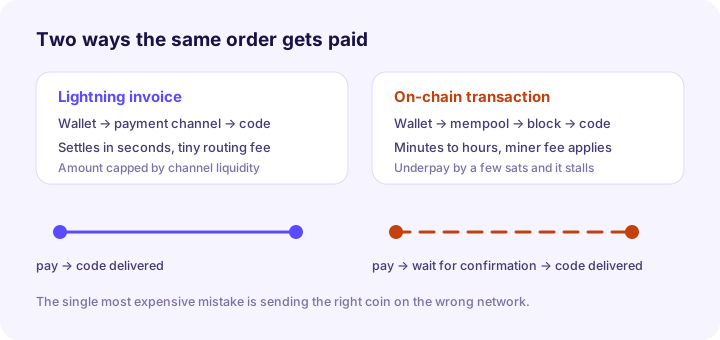
Lightning is a payment layer built on top of bitcoin. Instead of writing every transaction to the blockchain, funds move along pre-funded channels between nodes, and the blockchain is only consulted when a channel opens or closes. The practical effect at a checkout is that a payment settles in the time it takes to scan a QR code, and costs a rounding error.
For buying a $25 gift card, this is the correct choice and nothing else comes close. Wallets like Phoenix, Wallet of Satoshi, Blink or Breez handle it without you needing to know what a channel is.
The one limitation is size. A Lightning payment cannot exceed the liquidity available along a route, so a very large order may fail with an unhelpful error. That is not a merchant problem; it is a property of the network. Switch to on-chain or a stablecoin for large amounts.
Stablecoins: the default for anything substantial
Most people spending crypto at retail in 2026 are spending dollars, not bitcoin. Paying a $200 invoice in USDT removes the awkwardness of watching the exchange rate move while you find your hardware wallet, and it removes the question of whether you wanted to dispose of bitcoin at today's price.
The catch is that stablecoins are the assets most likely to be sent on the wrong chain, simply because they exist on the most chains. USDT alone lives on Tron, Ethereum, BNB Chain, Solana, Avalanche and more.
The chain named on the invoice is part of the address. Tron and Ethereum addresses look completely different, which helps — but BNB Chain and Ethereum addresses look identical, and that is where funds disappear. Confirm the chain in your wallet's send screen, every time.
On-chain bitcoin: correct for large orders, wasteful for small ones
An on-chain payment is the original method and still the right one when you are moving a meaningful amount from a hardware wallet. The cost is a miner fee that has nothing to do with your order size, which is why it is excellent on a $500 purchase and absurd on a $10 one.
Two rules make it reliable. Set a fee that will confirm within the rate window rather than the cheapest option your wallet suggests. And make sure the network fee is added on top of the invoice amount, not subtracted from it — the underpayment problem described in the buying walkthrough is almost always this setting.
Binance Pay and exchange-native transfers
Binance Pay appears among the accepted methods on the official site. It settles internally, which means no withdrawal fee, no chain selection, and no confirmation wait. For anyone whose crypto already sits on Binance, it is the path of least resistance.
Source: Binance Pay being listed as an accepted payment option — official Bitrefill websiteThe trade-off is identity. An exchange-native payment is executed by a fully verified account, so the purchase is attached to your legal identity in that exchange's records. If your reason for using crypto is to keep purchases off a bank statement, this method reintroduces most of what you were avoiding. There is nothing wrong with it — just be clear about what you are choosing.
Which wallets work: Trust Wallet, MetaMask, hardware devices
Any wallet that can send the asset on the right chain will work, because you are simply paying an address or a Lightning invoice. There is no connection step and no signature request, which is a meaningful security advantage over shops that ask you to connect a wallet to the site.
- Trust Wallet. Fine, multi-chain, and precisely because it is multi-chain it is where chain mix-ups happen. Select the network first, then the token.
- MetaMask. Good for ETH and EVM stablecoins. Check which network is active in the top-left before you send; a payment on Arbitrum will not satisfy a mainnet invoice.
- Lightning wallets. Phoenix, Blink, Wallet of Satoshi and similar. Note that custodial Lightning wallets hold your funds; that is a trade-off for convenience on small balances, not a permanent home for savings.
- Hardware wallets. The safest place for the funds, the least helpful at preventing chain mistakes. Verify on the invoice, not on the device screen.
Cards, Apple Pay and Google Pay
The official site now advertises credit cards, Apple Pay and Google Pay alongside crypto. This is genuinely convenient and it changes what the platform is for: at that point you are using a gift card marketplace with a card, and the crypto part is optional.
Two honest caveats. Availability varies by country and card issuer, and some issuers decline gift card purchases outright as a fraud-prevention default. And paying by card removes the privacy argument entirely, since the transaction appears on a statement like any other. We go through the mechanics on the Apple Pay page.
Still deciding? Start with the walkthrough
The payment rail only matters in the context of the whole order. The step-by-step guide shows where the network choice appears and what to check before you approve anything.
Questions people actually ask
Which payment method is cheapest?
Lightning for anything under roughly a hundred dollars, because routing fees are negligible and settlement is instant. Above that, a stablecoin on a low-fee chain such as Tron or Solana is usually cheaper than on-chain bitcoin and far cheaper than USDT on Ethereum.
Can I pay from Binance without withdrawing first?
Binance Pay is listed among the accepted methods on the official site, which lets an internal transfer settle the invoice without an on-chain withdrawal. It is fast and avoids withdrawal fees, but it means the payment is fully attached to your verified exchange identity.
Does Trust Wallet work?
Yes — it is an ordinary non-custodial wallet, so it works the same as any other. The only thing to watch is the chain selector, because Trust Wallet holds many versions of the same token. Pick the network the invoice names, not the token with the most familiar logo.
Is there a minimum payment amount?
Effectively yes, set by the product rather than the payment method: the smallest denomination the brand sells. Below about ten dollars, on-chain fees start to consume a visible share of the order, which is a practical minimum of its own.
What if my wallet does not support the network on the invoice?
Change the invoice, not the wallet behaviour. Go back to checkout and select a coin and chain your wallet actually holds. Never try to approximate — sending a similar asset on a different chain is the single most expensive error in this whole process.
Nobody legitimate ever needs your seed phrase or private keys — not a shop, not support, not a giveaway. Write those twelve or twenty-four words on paper, keep them offline, and treat any request for them as a confirmed scam.